Subterranean termite mitigation addresses the Eastern subterranean termite, the primary structural pest active across Northwest Ohio soils. In historic neighborhoods like the Old West End and Beverly, stone foundation…
Subterranean termite mitigation addresses the Eastern subterranean termite, the primary structural pest active across Northwest Ohio soils. In historic neighborhoods like the Old West End and Beverly, stone foundation walls and ground-contact floor joists frequently interface with clay-heavy soil that retains moisture along the Maumee River basin. When structural wood maintains moisture levels above 20%, subterranean colonies construct protective shelter tubes across foundation footings to access sill plates, wall studs, and subfloors. Left unchecked, a single colony containing 60,000 to 1,000,000 workers hollows framing timbers along the grain, leaving only an outer shell of paint or wood veneer.
Effective mitigation relies on two distinct protocols: liquid perimeter soil treatments and active monitoring baiting stations. A non-repellent liquid termiticide application creates a continuous treated zone through shallow trenching around exterior perimeters and rod-injecting soil abutting footers. Workers pass through this barrier without detection, transferring the active agent to the subterranean colony via grooming and shared food transfer, which eliminates the queen within 60 to 90 days. For properties in Point Place near Lake Erie or sites adjacent to Ottawa Park with shallow water tables or porous fieldstone foundations, in-ground baiting stations installed at 10-foot to 15-foot intervals around the roof drip-line avoid excessive liquid soil saturation while providing continuous year-round suppression through chitin synthesis inhibitors.
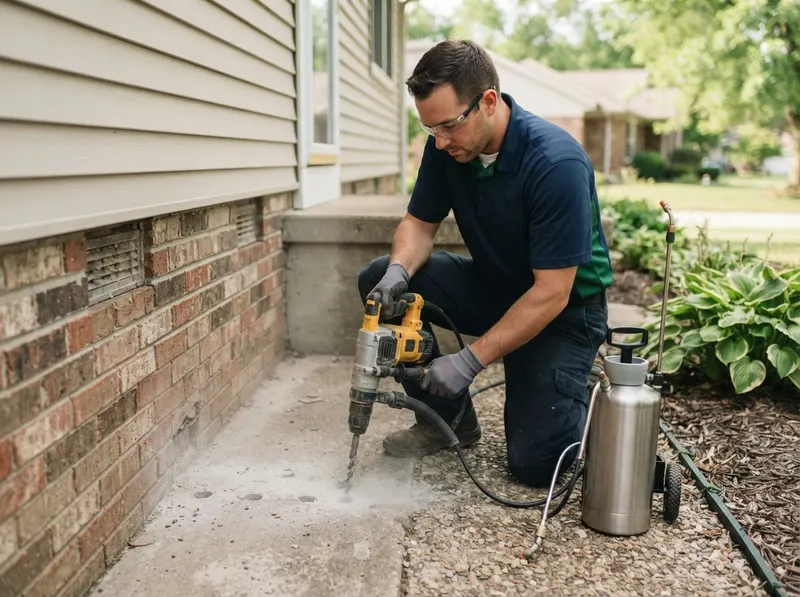
Trade-offs between these two protocols center on structural design and installation impact. Liquid barriers provide prompt protection of the structural perimeter upon application, yet older brick and slab foundations in Five Points, West Toledo, and the Warehouse District often require precision drilling through concrete porches, garage slabs, or basement perimeter slabs at 12-inch intervals. Baiting matrices eliminate the need for drilling interior or exterior concrete surfaces, but colony eradication requires methodical quarterly consumption cycles rather than immediate contact mortality. Localized foam treatments into structural wall voids resolve active interior galleries directly, preventing further hollowed timber failures while the larger soil colony is controlled.
Every job gets a firm, written price after a free on-site visit.
Tell us about your subterranean termite mitigation job in Toledo and we'll send a clear, written quote, usually the same day.
 TerraSafe Pest Co.