Carpenter ants (*Camponotus pennsylvanicus*) do not consume cellulose like subterranean termites; instead, worker ants excavate smooth nesting galleries directly into structural dimensional lumber, floor joists, and…
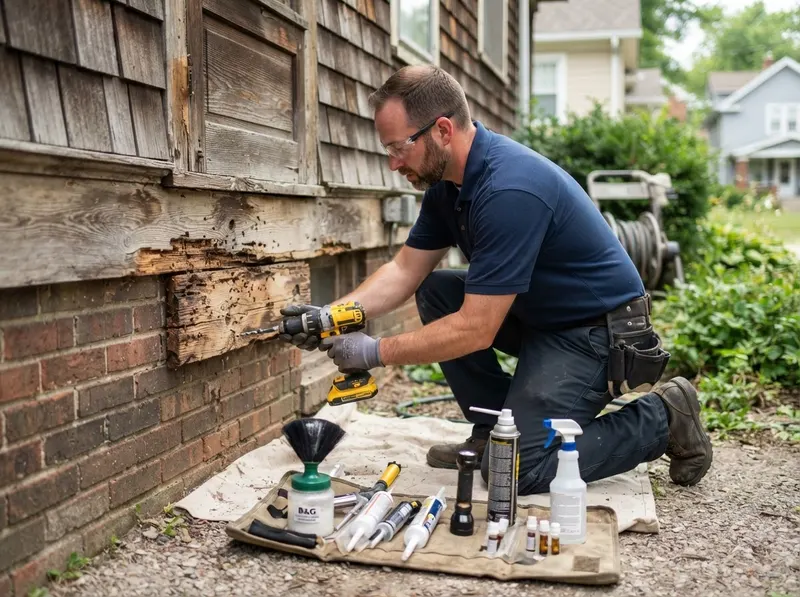
Carpenter ants (*Camponotus pennsylvanicus*) do not consume cellulose like subterranean termites; instead, worker ants excavate smooth nesting galleries directly into structural dimensional lumber, floor joists, and wall studs. In Lucas County homes, especially properties near the Maumee River basin, Ottawa Park, or heavily wooded parcels in Point Place and Beverly, persistent interior humidity and exterior roof leaks soften softwoods, making wall plates prime excavation sites. The remediation protocol addresses both visible satellite foraging tracks and hidden structural cavities without pumping broad-spectrum synthetic neurotoxins through living areas. Direct delivery of targeted micro-dusted active ingredients reaches deep inside wall voids behind baseboards, preserving indoor air quality while eliminating the reproductive hub.
Selecting structural remediation over general exterior baseboard spraying is necessary once frass, a telltale material resembling wood shavings mixed with insect fragments, accumulates beneath subfloors or windowsill ledges. Surface sprays fail because worker ants merely re-route their foraging lines through alternative stud bays, leaving the interior parent queen intact to produce up to 20 to 30 workers per day. A localized single-zone remedial treatment fits an isolated moisture leak around a bathroom subfloor in West Toledo, whereas an extensive multi-zone treatment is required for historic timber framing in the Old West End or the Warehouse District, where crawlspaces connect multiple satellite nests across wide joist spans. The trade-off between localized void intervention and full perimeter structural exclusion involves initial scope: treating a single wall bay halts active chewing immediately, but neglecting moisture-softened fascia boards leaves building envelopes susceptible to re-infestation within 12 to 18 months.
1. Technicians measure indoor relative humidity and conduct physical inspections across plumbing access walls, crawlspaces, and exterior wood-to-ground contacts. 2. Acoustic sounding locates hollowed-out timbers and nesting galleries behind drywall without requiring large-scale wall demolition. 3. Precision drilling creates 1/8-inch access points directly into verified galleries to deliver family-safe, non-repellent structural dusts. 4. Exterior perimeters are shielded with undetectable transfer compounds, ensuring outside foragers carry active materials back to the master queen.
Every job gets a firm, written price after a free on-site visit.
Tell us about your carpenter ant structural remediation job in Toledo and we'll send a clear, written quote, usually the same day.
 TerraSafe Pest Co.