Rodent mechanical exclusion addresses structural entryways directly, removing the health hazards of droppings in insulation and late-night drywall scratching. In historic structures throughout the Old West End and West…
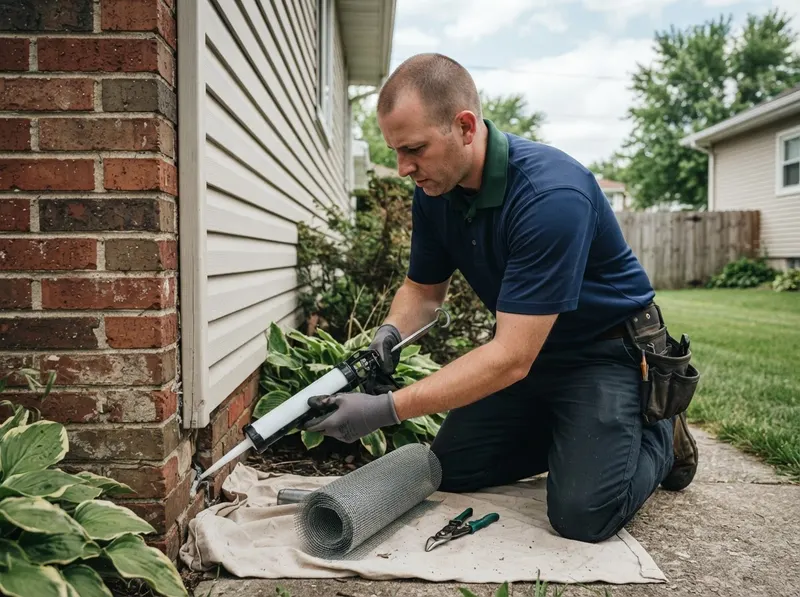
Rodent mechanical exclusion addresses structural entryways directly, removing the health hazards of droppings in insulation and late-night drywall scratching. In historic structures throughout the Old West End and West Toledo, settling sandstone foundations and aged fieldstone basements frequently yield gaps over 0.5 inches wide, creating unobstructed corridors for Norway rats seeking winter warmth near the Maumee River. Waterfront properties along Point Place face similar pressure, where moisture rots low sill plates and lake winds push mice beneath wood trim. Physical exclusion remedies these pathways by mechanically fastening rigid steel barrier components directly to brick, mortar, wood, and concrete, securing interior living quarters from fecal contamination, chewed electrical lines, and nest construction.
Deciding between mechanical exclusion and repeating chemical bait traps centers on permanent perimeter integrity versus ongoing toxicity exposure. Routine poison placement requires constant replenishment, risks secondary toxicity to domestic pets, and frequently leaves rodents to die and decompose out of reach behind interior baseboards. Mechanical exclusion requires an upfront investment in metal fabrication and carpentry, but it eliminates interior access points entirely. For newer split-levels in Franklin Park, crawlspace and brick-weep vent sealing resolves seasonal mouse intrusions permanently, whereas large multi-unit structures in the Warehouse District and Birmingham require overhead industrial roof vent covers and garage door brush seals to halt roof-rat climbing routes along external downspouts.
Executing exclusion follows a strict structural sequence: 1. Identification: The building exterior is mapped to locate every aperture exceeding a quarter inch, including foundation weep holes, AC line set penetrations, attic louvers, and crawlspace hatches near Ottawa Hills. 2. Barrier fabrication: Techs cut 19-gauge galvanized wire cloth, shape aluminum coil stock, and pack copper mesh into expansion joints around natural gas meters and water main spigots. 3. Fastening: Metal barriers are pinned mechanically using masonry anchor screws and hydraulic cement, resisting gnawing teeth that exert up to 7,000 pounds per square inch of bite force. 4. Interior capture: Any rodents trapped inside the thermal envelope post-seal are removed using humane mechanical snap traps over a 7-day monitoring span.
Every job gets a firm, written price after a free on-site visit.
Tell us about your rodent mechanical exclusion job in Toledo and we'll send a clear, written quote, usually the same day.
 TerraSafe Pest Co.